6/8 Sarajevo
今日到tunnel museum 參觀,它是內戰時BiH 和外界的唯一通道,由士兵徒手挖掘。坐三號tram (從Baščaršija出發)去尾站 Ilidža,在附近再轉巴士32a去總站Donji Kotorac okretnica,步行8分鐘至TUNELI ,巴士站並沒有任何車路線的標示,全部路線在心中。所以先在網上找好路線,再問問人就會找到。


Vedran Smajlović: Cellist of Sarajevo still moves the world

VEDRAN SMAILOVIĆ:
THE BRAVE CELLIST OF SARAJEVO
STILL MOVES THE WORLD
BY DANIEL BUTTRY

Photos by Evstafiev Mikhail, released via Wikimedia Commons.
You ask me am I crazy for playing the cello? Why do you not ask if they are not crazy for shelling Sarajevo?Vedran Smajlović
I’ve been to countless Bosnian memorials: Srebrenica where Serb militiamen massacred more than 8,000 Muslim men; the bridge in Sarajevo were snipers gunned down two students who were the first victims of the war; the square in Tuzla where dozens of Croat, Serbian and Muslim youths were partying together when a mortar shell erased their lives. When I heard of Smajlović’s musical memorial—an elegy played as sniper bullets whizzed around—I knew I had come to the heart of sorrow as well as a healing courage. I can’t read his story without weeping for all my Bosnian friends.
Daniel Buttry
Daniel Buttry
The musician took his place, dressed in the customary formal black tails and white shirt.
He sat on the stool with his cello between his legs. He took the bow and began to play Albinoni’s Adagio in G Minor. He was not in a concert hall. Instead he sat in a crater where the day before, 22 people had died.
He sat on the stool with his cello between his legs. He took the bow and began to play Albinoni’s Adagio in G Minor. He was not in a concert hall. Instead he sat in a crater where the day before, 22 people had died.
Vedran Smajlović (sometimes spelled Smailović) was the principal cellist of the Sarajevo Opera. He also played in the Sarajevo Philharmonic Orchestra, the Symphony Orchestra RTV Sarajevo and the National Theatre of Sarajevo. In the early 1990s, though, life was difficult for everyone in Sarajevo as war broke out. Yugoslavia was splintering into various nations, including what would become of Bosnia and Herzegovina. Serb nationalists surrounded Sarajevo and laid siege. For Smajlović and the other residents of the city, life was a daily ordeal of trying to find food and water amid the shelling and sniper fire that claimed many innocent lives.
On May 27, 1992, a long line of people had queued up at one of the still-functioning bakeries. A mortar shell fell into the middle of the line, killing 22 people and creating a bloody mess of body parts and rubble. Smajlović lived close to the bakery and was appalled by what he saw as he helped the wounded. He felt powerless as he was neither a politician nor a soldier—he was a musician, who could speak truth to the heart beyond any language.
Smajlović took his cello to the spot where those waiting for bread had been butchered and began to plaintively play. He played in a daze but in an incredibly evocative way. In spite of the risk, people gathered to listen. When he was finished he packed up his cello and went to a coffee shop. Quickly people came up to him expressing their appreciation, “This is what we needed.” Smajlović went back the next day and the next 22 days, one for each person killed. Sniper fire continued around him and mortars still rained down in the neighborhood, but Smajlović never stopped playing.
Then he went to other sites where shells had taken the lives of Sarajevo’s citizens. He played there, and he played in graveyards. He played at funerals at no charge, even though the Serbian gunners would target such gatherings. His music was a gift to all hiding in their basements with rubble above their heads, a voice for peace for those daily dodging the bullets of the snipers. As the reports of Smajlović’s performances on the shattered streets spread, he became a symbol for peace. A reporter questioned whether he was crazy to play his cello outside in the midst of a war zone. He countered, “You ask me am I crazy for playing the cello, why do you not ask if they are not crazy for shelling Sarajevo?”
His courageous performances inspired other musicians. Composer David Wilde wrote “The Cellist of Sarajevo” for cello in his honor, and Yo-Yo Ma, perhaps the world’s most famous cellist, recorded it and later embraced Smajlović following a performance of the piece. Various folk songs and even a children’s book have been written about his action.
In late 1993, Smajlović left Sarajevo. He has continued his musical career as a cellist, and still composes and conducts. He moved to Northern Ireland where he collaborated with Tommy Sands, an Irish folk musician with a large peace repertoire. Their “Sarajevo to Belfast” album celebrates perseverance, peace and healing through situations of violence.





Tunnel museum 是一間屋,內戰時軍方認為要有對外的通道,但這地比較好,所以選了此重要的地方。它由士兵挖掘,用木撐起,裡面舖了路軌,方便所有補給物資的運送,包括食物、藥物和自製的槍枝,它支持整個城市/市民的艱苦歲月。
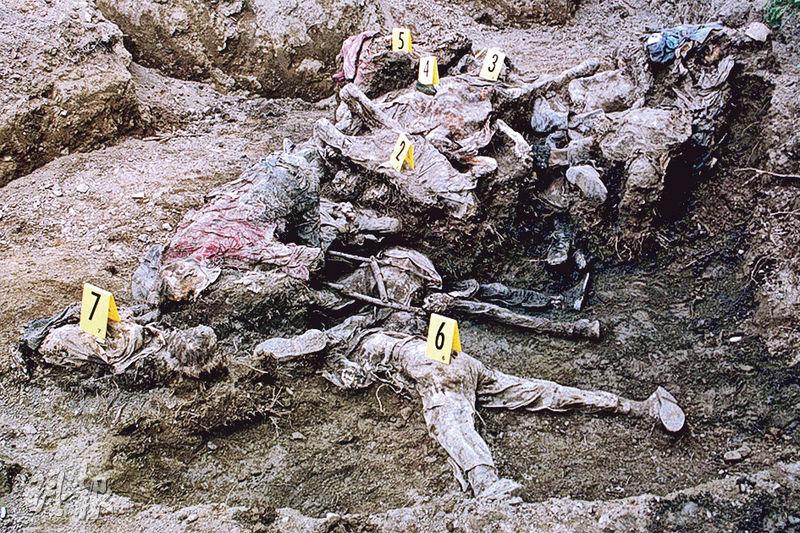
下午到了舊城,參觀了二戰以來最大的種族清洗屠殺展覽Gallery 11/07/95,當中提及的種族清洗,我沒有留意,但一面聽著語音導賞,一面看相片、短片,非常震撼,一個國家太大,種族太多,不能容忍和自己不同的人,整個過程北約、聯合國也明知要行動,為了保護那些Serbian army 對Bosnia Muslim 種族清洗,宗教種族仇恨沒完沒了,其中一個原因是Serbia 認為很難管治,而Bosnia Muslim 的祖先是ottoman,所以要報仇。而in refugee camp 又不夠難民住,所以有些就出事了... ... 館內說出很多動人故事,聽了也會戚戚然,家人無止境的等待家中所有男人回來,但卻永遠不會回來,連屍骨也難以找到,因為有三個mass grave, 原因是Serbia army 怕惡行被發現,所以要搬屍,所以最後連屍骨也難入土魂安。


//Srebrenica


這個gallery 利用圖片和documentary道出二戰以後歐洲最大規模的種族清洗(Bosnia Muslim男人被Serbia army 在Sbrenica refugee camp大屠殺)的故事。由於雙方有牙齒印,加上北約又似乎坐視不理,最後慘劇在11/07/95發生,參觀完後,心裡非常震撼。Serbia army 把所有Bosnia Muslim 男人,由refugee camp捉出去, 在樹林,把一個又一個的Bosnia Muslim 所有男人,不論歲數,不論是小孩成人長者,總知是男人,把雙眼朦起,叫他們排成一行,慢慢等待,逐一射殺,偷走的人即被射死。而Serbia army 為了掩飾惡行,所以就移屍30km,把已埋的屍首,胡亂地再挖出,就算Bosnia 女人想找回家中所有男人屍首骸骨也難以找到。事後用了好幾年去收集屍骨、驗DNA,找到親友骸骨已是萬幸,找不到的就回想之前一起快樂生活的動人時光,透過倖存者(女人)的描述,埋怨自己,又無止境的等失聯的家人「回來」,既慢長、痛苦和無奈。實在非常悲傷。來BiH之前,我只知WW1和薩拉熱窩的羅密歐與茱莉葉,現在我知道更無人道的事,也更明白民宿主人對內戰的看法。來到BiH真的學到很多人性。
下文是事次種族清洗的來龍去脈:
//Srebrenica
At the height of the vicious Bosnian War,
in 1993, the UN Security Council adopted its Resolution 819, placing
Srebrenica, a small town in Eastern Bosnia and Herzegovina, under the
protection of the international peace forces. The Resolution stopped the takeover
of Srebrenica by the Army of Republika Srpska and demilitarized the area,
designating it as a UN protected area, and this was a momentary rescue of some
40,000 Muslim refugees from Eastern Bosnia. After having been expelled from
other occupied towns and villages of the area, they found refuge in Srebrenica.
Despite the UN protection, the Army of Republika Srpska still treated
Srebrenica as a legitimate military target, shelling it from time to time and
constantly blocking aid convoys, even after two years of relative peace and
international protection.
Two years after the signing of the Security
Council Resolution, on 6 July 1995, an all-out attack was launched. On 11 July
1995, the Republika Srpska troops led by General Ratko Mladić entered the town.
General Mladić made a triumphant statement in front of TV cameras, stating that
he had finally entered the “Serb Srebrenica” and that “time has finally come
for revenge against the Turks”. His words gave a precise ideological narrative
underlying the crime. The events that unfolded in the coming days were defined
by the International Court of Justice in The Hague as a crime of genocide.
The military operation entitled “Krivaja
95” resulted in monstrous killings of more than 8,000 Bosnian Muslims, mainly
men, but also women and children. To this day, the exact number of confirmed
deaths has reached 8,372.
The killings were systematic, well
organised and quick, with no possibility for the demilitarized Bosnian Muslim
forces to offer any resistance – but they were also with no response from the
international community, first and foremost from the Dutch Battalion, assigned
to the Srebrenica enclave. Although the international public knew about the
events in Srebrenica as they were happening, the international community did
not react and the NATO forces failed to send the air support they had promised.
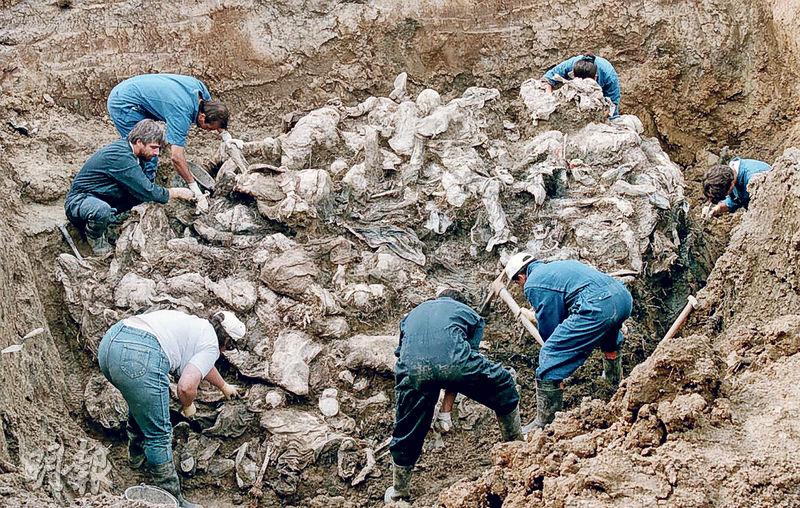
Subsequent investigations and DNA analyses
revealed that during the summer and autumn of 1995, the bodies of men and women
who had been executed were exhumed from the primary mass graves and moved to
other, hidden locations. Remains of the victims were found in primary,
secondary, even tertiary mass graves. The process of exhumation and
identification of victims continues to this day. And it seems that even 20 years
after the war, the real uncovering of truth, admission of guilt and
reconciliation have not even started yet.//
我對歷史就沒有濃烈的興趣,但是對生命就比較關心。
世界上有些地方和民族,實在與我們零關係。不過,人心是一個共通橋樑,看到這段片,明白「UN 算什麼」、「北約算什麼」,當你以為你是被保護,而事實是人家為什麼要保護你?這是極無助又憤怒的心情。以為安全區難民營是求生之地,竟然被敵人視為一網打盡的良機,多恐怖。如果當初UN,北約,你保護不了Bosnia Muslim, 點解又要開這種期票。局勢既野,我不是完全了解。但就咁聽落都覺得慘。(最近想了解的課題,也許這課題和香港有太遠的距離)
世界上有些地方和民族,實在與我們零關係。不過,人心是一個共通橋樑,看到這段片,明白「UN 算什麼」、「北約算什麼」,當你以為你是被保護,而事實是人家為什麼要保護你?這是極無助又憤怒的心情。以為安全區難民營是求生之地,竟然被敵人視為一網打盡的良機,多恐怖。如果當初UN,北約,你保護不了Bosnia Muslim, 點解又要開這種期票。局勢既野,我不是完全了解。但就咁聽落都覺得慘。(最近想了解的課題,也許這課題和香港有太遠的距離)
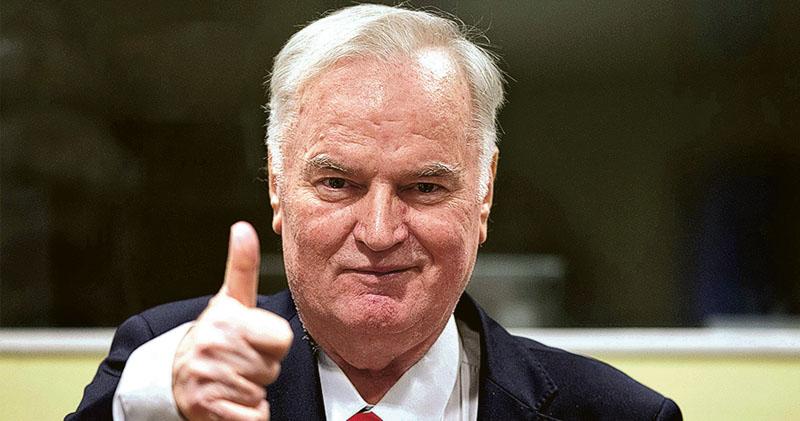
終於拉左塞爾維亞個個種族清洗的狂徒!👏🏻二十年。 九十年代波斯尼亞內戰。他是塞爾維亞族軍官,他只想BiH純淨塞族血統。所以成為Sarajevo 圍城及srebrenica種族清洗的始作俑者。他曾一次過在srebrenica 殺死所有波斯尼亞伊斯蘭男性,大部分家庭只剩一批女性,在他們傳統社會,女性不應獨立於男性而生活。所有婦女在家等待他們的男人,但永遠也等不到。他仲要為了掩飾惡行,把屍體一共搬了三次亂葬崗,就算死了家人一點點遺物遺骸也找不到。有些人寧願找到一點點,可以死心,但是,仍有很多人什麼也沒有找到,每天希望家人回來但仍是失望告終。在sarajevo 圍城,令很多人死亡。今日終於判刑,惡人有惡報!很開心!
「波斯尼亞屠夫」罪成囚終身 前塞族軍司令姆拉迪奇被控種族滅絕
明報2017.11.23
明報2017.11.23
 |
 |
 |
 |
 |
由多個巴爾幹半島國家組成的南斯拉夫聯邦於1990年代初隨「鐵幕」倒下解體,其中波斯尼亞於1991年宣布獨立,引起塞爾維亞人強烈反對,終觸發內戰。姆拉迪奇於1992至1995年內戰期間擔任波斯尼亞塞族武裝司令,雖然聯合國於1993年通過決議,將位於波斯尼亞東部的斯雷布雷尼察列為「安全區域」,由聯合國維和部隊駐守,但姆拉迪奇的塞族部隊仍於1995年7月向當地發動猛攻,並殺害8000名波斯尼亞穆斯林,主要為男性,史稱「斯雷布雷尼察大屠殺」(Srebrenica massacre),被視為二戰後歐洲最慘烈的屠殺。
下令「斯雷布雷尼察大屠殺」
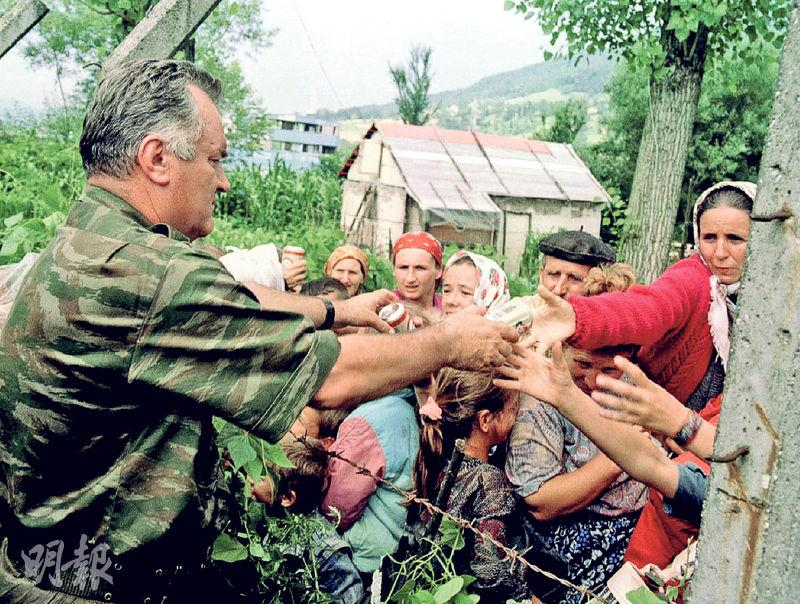
倖存者組織「斯雷布雷尼察母親」發言人稱,塞族軍人攻陷斯雷布雷尼察後,姆拉迪奇曾在電視台拍攝下到訪當地的難民營,並向兒童派發糖果與朱古力,聲稱不會發生任何事,但攝製隊一離開,他便下令展開屠殺及強姦。不少目擊者表示,當時來自荷蘭的維和部隊一直旁觀塞族軍人帶走波斯尼亞的男子與男童運到遠處殺害,並未出手制止。
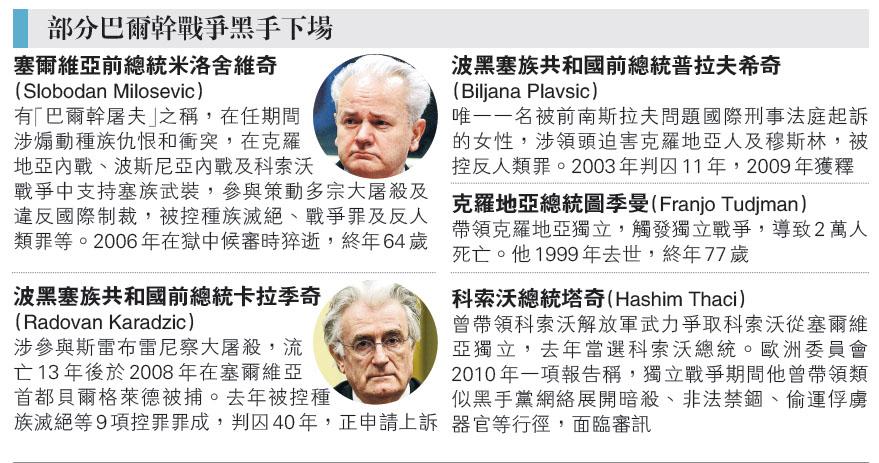
姆拉迪奇是迄今被控的最高級前塞族軍事人員,他被指與波斯尼亞塞族政治領袖卡拉季奇及塞爾維亞總統米洛舍維奇聯手展開種族清洗,試圖建立純塞族國家,至今仍被塞族人視為民族英雄。大屠殺結束後,姆拉迪奇與卡拉季奇一度落網,及後逃脫流亡,至2011年在塞爾維亞北部被捕。姆拉迪奇被控11項罪名,包括種族清洗、違反戰爭法等罪名,亦因圍攻薩拉熱窩令1.1萬名平民死於轟炸或狙擊,被控反人類罪。
聯國人權專員﹕公義大勝
74歲的姆拉迪奇近年多次中風,法庭亦因其健康問題延後審訊4年。其代表律師堅稱,姆拉迪奇在大屠殺發生前曾短暫離開當地,對種族清洗不知情,責任存在疑點。姆拉迪奇周三進入法院時一度起立大叫,堅稱自己身體不適,又斥控罪全是謊言,最終被趕到另一房間聽審。
法官隨後宣判,姆拉迪奇「顯著推動」斯雷布雷尼察發生的種族滅絕行動,又「親自指揮」對薩拉熱窩的長期轟炸,又參與「犯罪組織」,意圖將穆斯林及克羅地亞人驅逐出波斯尼亞,斥姆拉迪奇「犯下針對人類最十惡不赦的罪行」,除了其中一項種族清洗罪不成立外,其餘10項控罪成立,判處終身監禁。
聯合國人權事務高級專員侯賽因(Zeid Ra'ad al-Hussein)發表聲明,斥姆拉迪奇是「邪惡的典型」,被定罪是「公義的重大勝利」。
(綜合報道)明報2017年11月23日


